Keyword Density Checker — Free SEO Tool
Analyze keyword density in any text to optimize content for search engines. Find the top words by frequency and ensure natural keyword usage.
Keyword Density: The Balance Between Relevance and Penalty
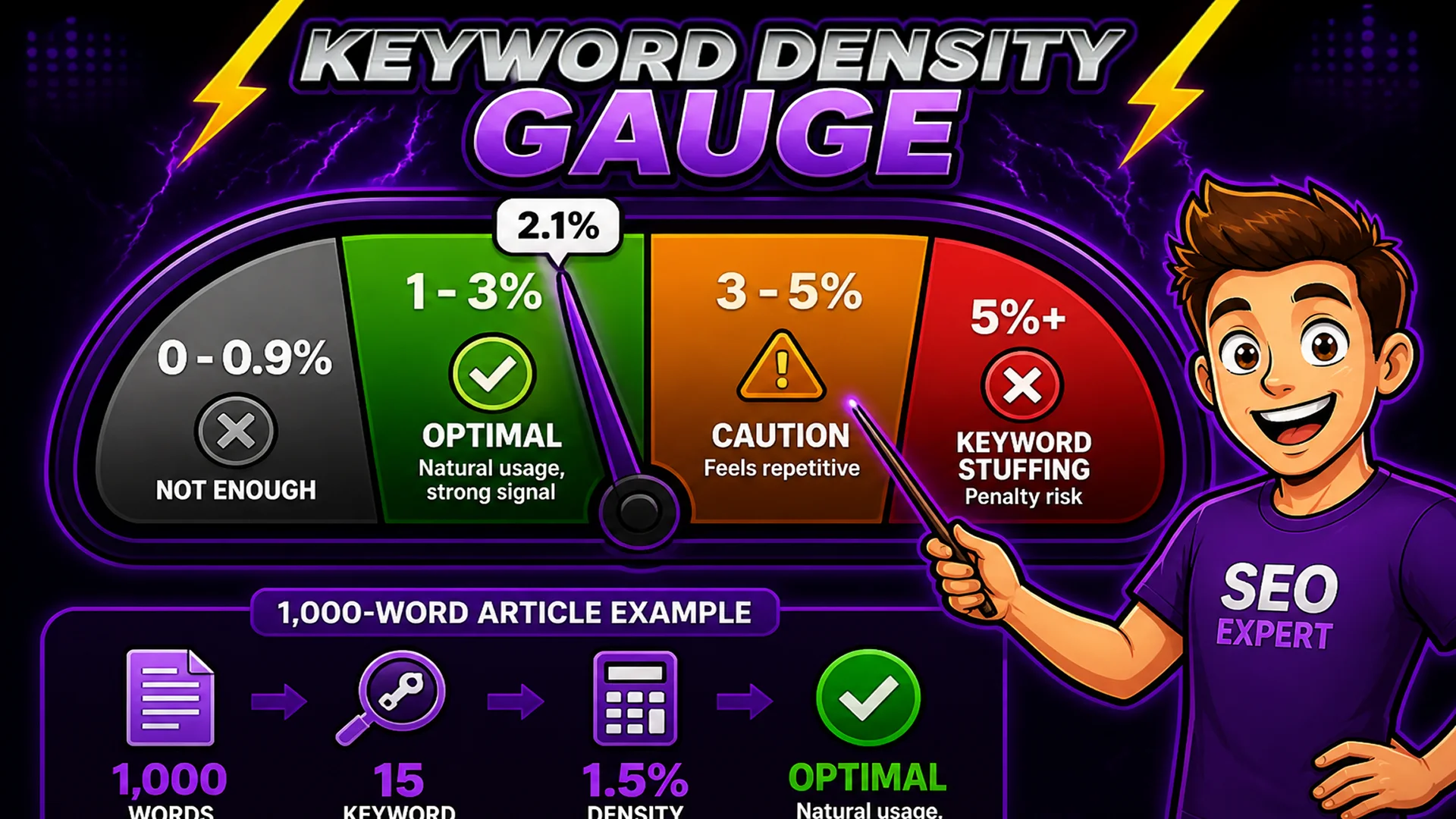
Keyword density is the percentage of times a target word or phrase appears in a piece of text relative to the total word count. It is one of the factors search engines use to determine whether a page is genuinely relevant to a query — but it has an important ceiling. Use a keyword too rarely and search engines may not recognize the page as highly relevant. Use it too frequently and the page risks being flagged for keyword stuffing, a practice that Google actively penalizes.
The optimal keyword density for a primary keyword is generally 1–3% of total word count. For a 1,000-word article, this means the primary keyword appears 10–30 times — once every 33 to 100 words on average. The Toolsnests Keyword Density Checker analyzes any text and shows you exactly where you stand.

What Is Keyword Stuffing and Why Does It Hurt Rankings?
Keyword stuffing is the practice of overloading content with a target keyword to the point where the text reads unnaturally. In the early days of SEO (pre-2012), high keyword density correlated with higher rankings. Google's Panda algorithm update in 2011 changed this, penalizing pages with unnaturally high keyword density and rewarding natural, reader-focused content.
Modern search algorithms evaluate semantic relevance — whether a page comprehensively covers a topic — rather than simple keyword frequency. A page that uses a keyword 50 times in 500 words will rank below a page that uses it 10 times in 1,000 words with related terms and comprehensive coverage, because the latter demonstrates genuine depth on the topic.
How to Use the Keyword Density Checker on Toolsnests
Open the Keyword Density Checker — no login, no installation.
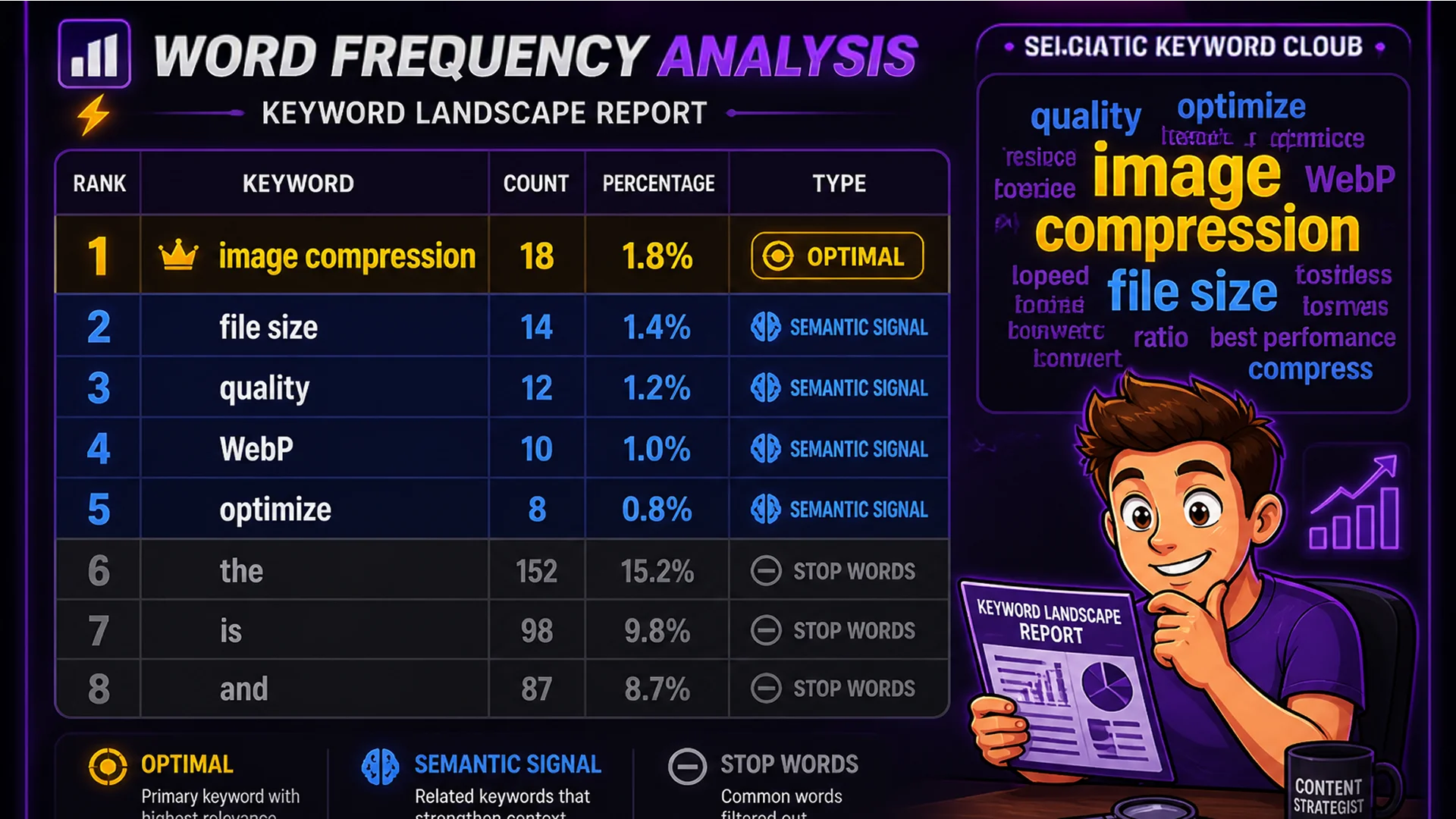
Step 1: Paste your article, blog post, or page content into the text area. Step 2: The tool analyzes the text and displays a ranked frequency list of all words, showing count and percentage of total word count. Step 3: Find your primary keyword in the list and check its density percentage. Step 4: If the density is below 1%, consider naturally adding the keyword in additional places. If it is above 3%, revise the text to reduce repetition and use synonyms.
Beyond Primary Keywords: Secondary and LSI Keywords
Modern SEO strategy focuses not just on one primary keyword but on semantic keyword clusters — groups of related terms that collectively signal topic expertise to search engines. Latent Semantic Indexing (LSI) keywords are terms that are contextually related to the primary keyword and appear naturally in expert content on the topic.
The word frequency report from the Keyword Density Checker is valuable for identifying which secondary terms you use naturally in your content — these are your implicit LSI keywords. If your article about 'image compression' naturally uses 'file size', 'quality', 'lossless', 'JPG', and 'WebP', those terms collectively signal to search engines that you have comprehensive knowledge of the topic.
Using the Checker for Content Auditing
The Keyword Density Checker is also valuable for auditing existing content that is underperforming in search. Paste the page content, review the frequency list, and look for: primary keyword appearing fewer than 10 times in a 1,000-word article (add it more naturally), competitor brand names appearing more than your own product name (reduce competitor mentions), unintended keyword focus on a term you did not plan for (the content may be targeting the wrong query), and stop words (the, is, a, an) dominating the list (normal — these are filtered in advanced analysis but visible in raw mode).
Related SEO Tools
Meta Tag Generator — create title tags and descriptions that include your optimized keywords. Sitemap Generator — ensure keyword-optimized pages are submitted for indexing. Word Frequency Analyzer — analyze word frequency in text for content strategy and editing.
Final Thoughts
Keyword density is one of the simplest quantifiable SEO signals you can optimize. The target is natural, reader-focused content where the primary keyword appears 1–3% of the time — enough for relevance signals, not so much that it reads as stuffed.
Paste your next article into the Keyword Density Checker before publishing and confirm your keyword usage is in the optimal range.